Sunday, August 26, 2012

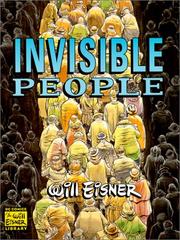
Invisible People by WIll Eisner


Will Eisner was one of the most recognizable names in comic history. He invented the graphic novel and changed sequential art doing what he loved. He has a yearly comic award that shares his name. For these reasons I have always wanted to read some of his work. However, the logical starting point, The Spirit, his serialized "superhero" story, has never appealed to me  - I do not think it will live up to its reputation. As a result I took the suggestion of a number of friends and critics whose opinion I trust and started with Invisible People (W.W. Norton).

This book is nicely put together, which can be especially important for graphic novels. There are no cut off images in the cracks (although Eisner doesn't seem to have that style) and no problem with binding. The book is divided into three stories, all of which deal with the anonymity and alienation of city life in a different way. Each story has a distinct flavor and contained plot, but they are designed to be read together.

I greatly admire the plotting of the stories. There is no wasted space, which astounds me as someone who has read their fair share of modern comics. The stories flow from one point to the next and it never seems choppy or rushed. 

The dialogue is a little sub-par at some points. Every time a character says the line "they are an invisible person," it feels forced and stale. For the most part though it is passable and standard, but nothing spectacular.

The substance of the stories is strong. They do an excellent job of imagining the lives of people we pass everyday and have no clue exist. The stories are simplistic in some ways: They are set in an earlier "simpler" time, the characters themselves are mostly archetypes, many of the complexities of the city are ignored to focus on the main themes listed above. However, these simplifications are not made unconsciously. Will Eisner states in his introduction that he chose to set the stories in the 1930's because the intricacies of modern city life are far more complex and difficult to navigate. Eisner is trying to paint a picture that does not need a modern backdrop. These stories could have been set in almost any major city throughout history - with obvious occupation and technology changes - and they would still work. This is because they are not simple. They are probing and capture a detailed image of one of the failures of city - particularly American city - life, the inability of its inhabitants to connect with everyone around them. 

The world of these stories is a mechanical system. Reminiscent of the great bureaucratic dystopian stories like Kafka's The Trial, the sense of immobility in the shadow of an oppressive and unforgiving way of life is beautifully realized in all its despair.

Individually, the drawings are mostly unspectacular, but competent work. Sequentially the art flows well from one point to the next. They manage to capture facial expressions and moods of the characters well. Overall, good cartooning, but not my favorite art.

Verdict: I would recommend this book to anyone interested in comics in the classic vein. I will read more of Will Eisner after reading this book, but I am in no rush to do so. 

Let me know what you think below. I know this blog is slowly turning to the other kind of bi-weekly, but one day soon it should be back to twice a week!

Thanks for reading!

Friday, August 10, 2012

The Works of "Jason" - An Alert

Going to try something different already! I am going to talk about the work of an author I whose work is relatively new to me, but all around spectacular. Let me know what you think in the comments section below. 


The above picture is from a book of one of my favorite cartoonists, who uses the nom de plume, Jason. In the picture two boyhood friends play on a tree hanging over a cliff. In the previous scene the friend dressed in all white has jumped and swung around. Now his friend tries to imitate him but as you can see, he hesitates, he is concerned. It is from this page that the larger story gets its title "Hey... Wait!" 

I want talk a little about Jason and this page provides a good idea of the quality of his work. Although he is well received by critics, I think Jason is still an under-appreciated artist. His work not only delves deeply into the core of humanity, but its funny and easy to read. So far, I have read through two of the larger collections of his work published in translation by Fantagraphics: What I Did and Almost Silent. The first one surprised me. I was not expecting the poetic easy flow of his drawings and sparing use of dialogue (something that I feel is clear in the panel above). The second confirmed my opinion. 

If you have any interest in comics or are a purveyor of story in any form. I would give the work of Jason a read.  

For more information check out Comic Book Resources: Robot 6 Blog's Comic College on Jason.

Tuesday, July 31, 2012

Then We Came to the End by Joshua Ferris - Back Review

 For this first "Back Review" I am going to go with a book I read about three or four years ago. I randomly picked the book up in a bookshop. This is something that would almost never happen now, as I tend to over-think my book purchases. It had good reviews on the back and sounded like just the type of comedic, but elegantly written novel I was looking for at the time. The book is titled Then We Came to the End.


Then We Came to the End (Back Bay Books, 2007) is the debut novel of Joshua Ferris. It follows the lives of office workers at a Chicago advertising agency during the economic downturn of the 1990s. The characters are eclectic and odd. Yet, if you have ever worked in an office environment you will immediately recognize them in those around you. Their lives are insignificant and pointless. Their reasoning is often irrational. However, they are very funny.
This is the type of book that can, and will, make you both laugh and cry. 

The book draws on a number of intersecting stories to achieve this balance of comedy and tragedy. However, it sticks with its characters enough to let them all have their own story arcs.
The book is written in a non-linear manner, but it is not hard to follow. Still, I do not think the non-linearity was necessary, or added anything, to the story.

The book is told in a broad narrative style. It strives to make the reader part of the narrative. This technique never feels overdone and does a great job of making the reader feel at home in the novel. Towards the end it comes off a little cliche, but not necessarily in a bad way.

The prose is crisp and clean. One of my favorite paragraphs in this book comes early in the first chapter. It is a great example not only of this cleanliness, but also the themes in the book:
"...Might it be true, as we sometime feared on the commute home, that we were callous, unfeeling individuals, incapable of sympathy, and full of spite toward people for no reason other than their proximity and familiarity? We had these sudden revelations that employment, the daily nine-five, was driving us far from our better selves. Should we quit? Would that solve it? Or were those qualities innate, dooming us to nastiness and paucity of spirit? We hoped not."

This paragraph seems a nice ending summation of what to expect from the novel. If you work in an office and like to read I think you will enjoy Then We Came to the End

Please let me know what you think about this post, the book, or my blog in the comments below. Thanks for reading.

Thursday, July 26, 2012

The Flame Alphabet by Ben Marcus

For the first full review I have chosen a newer book by one of the more linguistically innovative mainstream contemporary writers. I used this blog as an excuse to purchase this book and to motivate myself to review more timely books. Now that I have it finished it is time to begin my blogging quest.


Postmodernism has a tentative relationship with language. I hesitate to say it is looked on as a necessary evil, because this is too cliche and does not appropriately convey the complicated nature of the relationship. However, postmodernism teaches to be wary of language's role in our world - perhaps it even is our world. This recent - and the biblical - trepidation towards language is a central theme in Ben Marcus's new novel The Flame Alphabet (Knopf © 2012 $25.95).

In the novel language is a deadly disease that rots the body and turns the mouth into a snarl. Only children seem to be immune to this pandemic. Their free use of language slowly harming, and giving them power over, the adults of society.

On its most basic level the novel is a story about what happens in a post-apocalyptic world when language is the apocalypse. As you can imagine large swaths of the novel pass by with minimal dialogue. It seems often a loophole has to be invented for direct communication. One of the most interesting aspects of this story is the way the characters, and we as readers, come to adjust to the lack of verbal communication. Even with its sparse dialogue the book moves at a quick pace and is never bogged down with overly expository passages.

The characters are one of the weaker points of the story. They are mostly caricatures: A mom who loves her daughter more than anything, a father trying to save his family, a daughter who hates the world, and a devil that does not seem very evil, are some of the primary players. Although this use of caricatures may be purposeful, these uses of the 'everyman' characters in post-apocalyptic fiction is an unfortunate trope in this reviewers opinion.  Despite the lack of depth to these characters they are still entertaining enough to move the plot forward.

The novel is almost meant to be inferred rather than understood. It is a parable about the overuse and abuse of language. There is no understanding as a result of our failures to define clearly the speech we are using. Marcus handles this concept well. Four chapters into the novel he spells it out to us in a great paragraph:
"... It troubled us that our common sense has so little medical traction. There were doctors, and there were armchair doctors, and then there were people like us, crawling in the mud, deploying childish diagnostics, hoping that through sheer tone of voice, through the posturing of authority, we would exact some definitive change of reality. Perhaps we thought the world we lived in could be hacked into pleasing shapes simply by what we said. Maybe we still believed that."

This seems to challenge the postmodern paradigm of language. It seems to say that although we think we can alter the world with language, and our bold assertions, we have so far been unable to prove it. Perhaps language does not shape the world around us as much as bring death to it. Perhaps our mindless talk is the ruination of the world. Perhaps language makes us feel like gods. As Marcus says, "we make language in our own image and the language repulses us."

The book suggests that it is our playful useless banter, our postmodern need to speak endlessly on topics to no greater understanding is dangerous. "Child's Play" is deadly. There is no innocence in our play with language and we must recognize our impact. Language is killing us. Shut up and listen, because only by studying the byproduct of our speech can we be cured.

The book is worth checking out, but based on what I have seen Marcus accomplish in his debut short story collection Age of Wire and String I have to admit I was expecting more. However, it is obviously unfair to level critique against a book that is trying to do something in a different way than its predecessors.

If you are interested Knopf produced a video trailer for the novel, a cool concept in itself (See below). Also, please comment and let me know what you think, give me advice, or just say hello.